A Study on Form and Gestural Transformation in Leo Brouwer’s “Elogio de la Danza” (I: Lento)
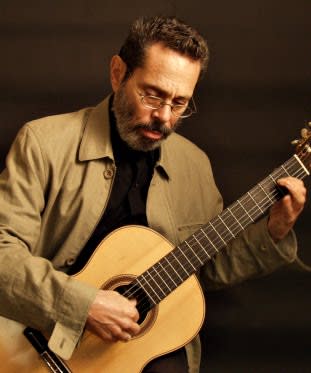
Leo Brouwer, born in 1939, is a Cuban composer, guitarist, and conductor. He is considered as one of the most prolific and respected classical guitar composers. “Elogio de la Danza” is a two-movement solo classical guitar piece composed in 1964, a few years after he was awarded a grant to study at Julliard School of Music. This piece showcases Brouwer’s experimentations on post-serialist techniques. This essay will delve into the first movement of this work, with a focus on analyzing musical form and tracing gestural transformations under the Set-Theory framework.
Preliminary Disclosures
This essay identifies three macro-sections of music based on the function that the musical material has on the overall form of the movement. They will be referred to as: Expositional macro section, Developmental macro section, and Recapitulatory macro section. Table 1 identifies the range of these macro-sections.
Additionally, each macro-section is comprised of smaller sections. They will be referred to as A, B, A₁, D, E, and A₂. Table 2 identifies the range of these sections.
Furthermore, each section within the macro-sections can be divided into smaller subsections. They will be presented and discussed as they become relevant in the analysis.
Expositional macro section
The expositional macro section of this movement is comprised of four main sections: A, B, A₁, and D. This macro-section has a slow tempo mark, “Lento”. When looking at the expositional macro section in isolation, apparent connections can be uncovered. Notice how A₁ iterates material presented at A. In a similar manner, B and D serve as transitions. Additionally, material present in sections B, A₁, and D can be directly traced back to the A section.
The A section arguably presents most of the musical material and themes that will be developed through-out the entire movement and composition. The A section can be divided in five subsections defined in Table 3.
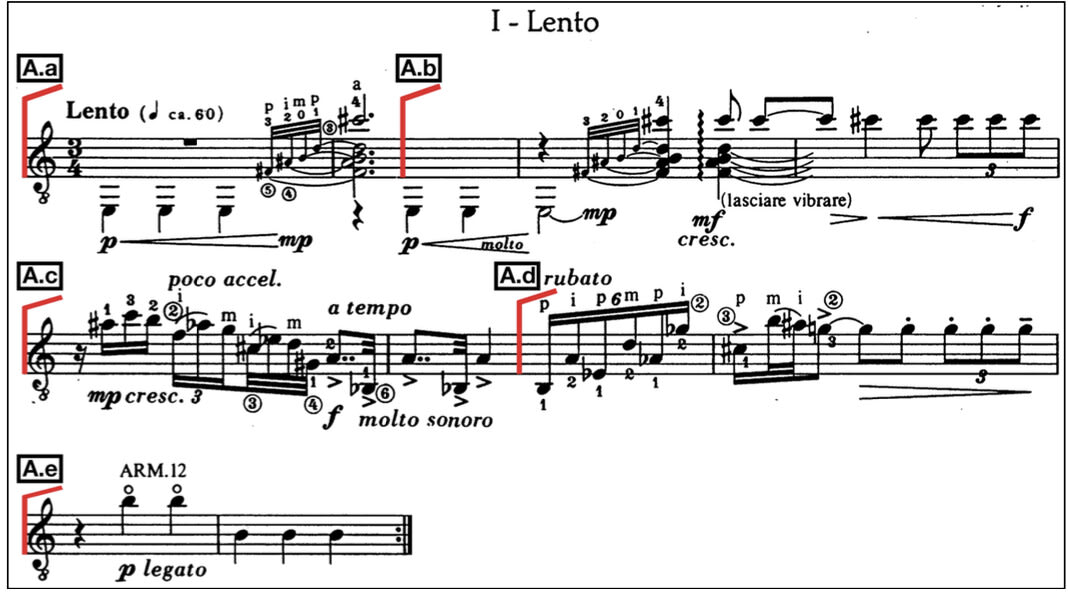
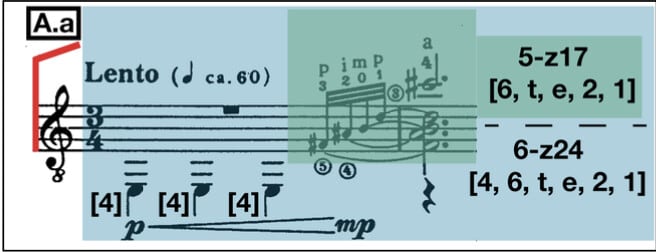
Subsection A.a is comprised of three reiterated statements of pitch-class [4] followed by an arpeggiated penta-chord described by pitch-collection [6, t, e, 2, 1]. This sub-section has two valid interpretations: one counting pitch-class [4] in the aggregate set, and another one excluding pitch-class [4] from the aggregate set. The subsequent music in the movement will validate both interpretations. The aggregate pitch-collection for sub-section A.a can be either: [6, t, e, 2, 1], or [4, 6, t, e, 2, 1]. Their Forte names are 5-z17 and 6-z24 respectively. As it will be discussed in the following analysis, pitch-class [4] is the most important structural marker of the movement and piece. For this reason, isolating pitch class [4] brings a deeper layer of insight on the structure of the piece.
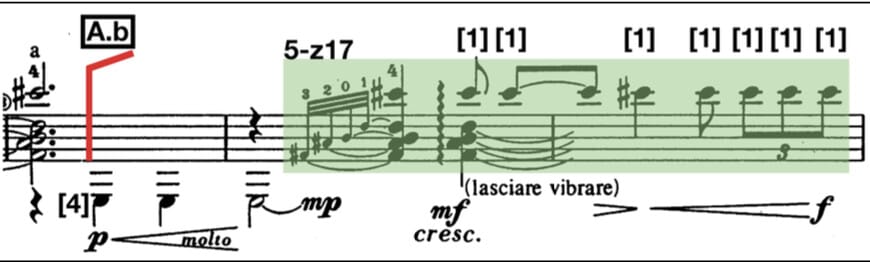
Subsection A.b expands on A.a gesture by adding a reiteration of the penta-chord 5-z17 as well as the repetition of the highest pitch in said penta-chord, pitch-class [1]. In an identical manner as subsection A.a, the aggregate pitch-collection for subsection A.b can be either 5-z17 or 6-z24.
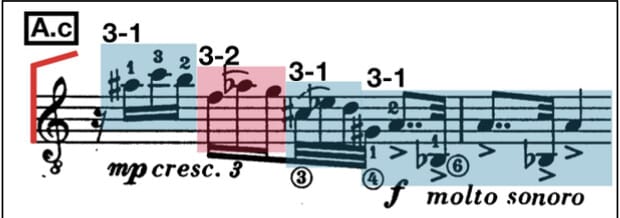
Immediately following the accelerating reiterations of pitch-class [1] that ended subsection A.b, the contrasting subsection A.c continues the rhythmic diminution presenting an accelerating descending crescendo gesture. Subsection A.c can be divided and condensed into four tri-chords. These four tri-chords can be further reduced if we calculate their Forte names. After this reduction process, Subsection A.c is comprised of tri-chords 3-1, and 3-2. In practice, Brouwer presents tri-chord 3-1, then, tri-chord 3-2, followed by a transposed iteration of tri- chord 3-1, and finalizes the gesture with another transposed 3-1 tri-chord presented with octave displacement.
Subsection A.d loosely mirrors A.c by presenting a rubato ascending gesture that culminates in reiterations of pitch-class [7]. This ascending gesture is comprised of two major 7th leaps followed by a two minor 7th leaps. The aggregate pitch-collection defining subsection A.d is [1, 2, 3, 6, 7, 8, 9, t, e] with Forte name 9-4.
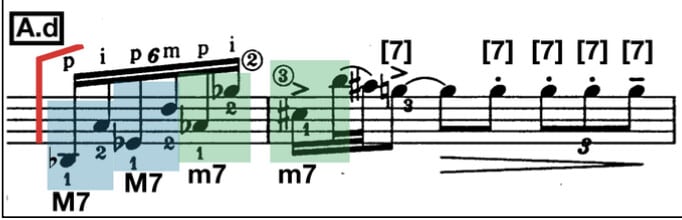
An interesting characteristic of subsections A.c and A.d is that they present a rare inverted crescendo curve. Traditionally, crescendo gestures often imply an ascension in pitch. In these subsections, Brouwer goes against common-practice and presents as a crescendo gesture that reaches its loudest point in its lowest pitches and has its quietest moments in its highest pitches.
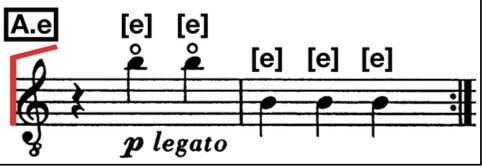
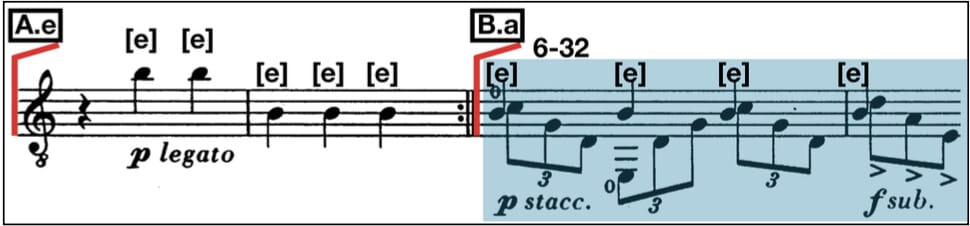
Culminating the A section, subsection A.e presents reiterated iterations of pitch-class [e] at two different octave levels. Subsection A.e seamlessly connects back to A.a. This is because Brouwer recapitulates the steady quarter-note rhythm and, pitch-class [e] is the third harmonic partial of pitch-class [4]. Due to the timber of classical guitar, the third partial is among the most prominent in its spectral analysis. This makes the transition from pitch-class [e] to [4] remarkably smooth. Additionally, Subsection A.e’s reiterated statements of pitch-class [e] arranged in a steady quarter-notes rhythm prepares the material for the subsequent section B.
At this point in the A section, notice how Brouwer strategically saves pitch-class [4] and only uses it at exposed pedal points in subsections A.a and A.b. This further proves that pitch- class [4] plays a huge role in the formal structure of the piece.
![Fig. 7. “A” section’s pitch-class [4] statements.](https://res.cloudinary.com/dpxg2qvgb/image/upload/f_auto,q_auto/v1768951812/fig_07_acbfiv.jpg)
As previously stated, the B section directly emerges from material presented in the A section. Specifically, Brouwer elaborates on the theme of reiteration initially presented in the A section and, takes pitch-class [e] present in subsection A.e, and makes it a fundamental driving theme for the B section. The B section can be divided in four subsections defined in table 4.
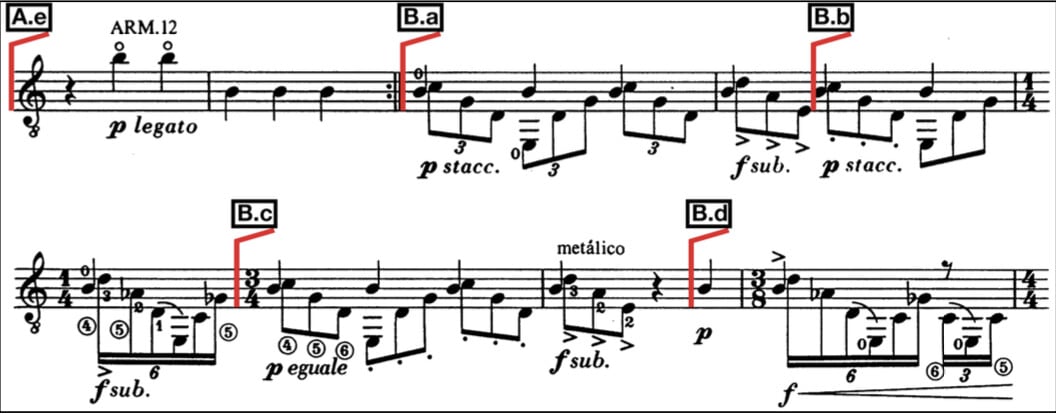
Subsection B.a introduces a contrasting staccato texture embellished with legato reiterations of pitch-class [e] that emerged from subsection A.e. The aggregate pitch-collection for subsection B.a is [0, 4, 7, 9, e] with Forte name 6-32.
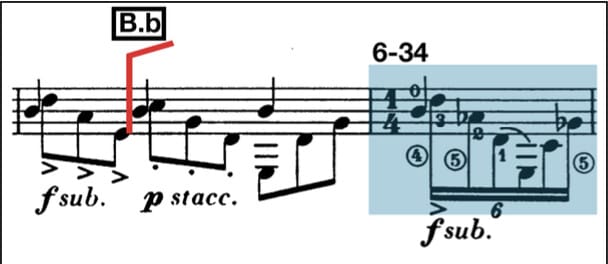
Subsection B.b keeps the same texture and adds a contrasting gesture on mm.12. This sextuplet gesture presents pitch collection 6-34 and is considerably more dissonant than Subsection B.a.
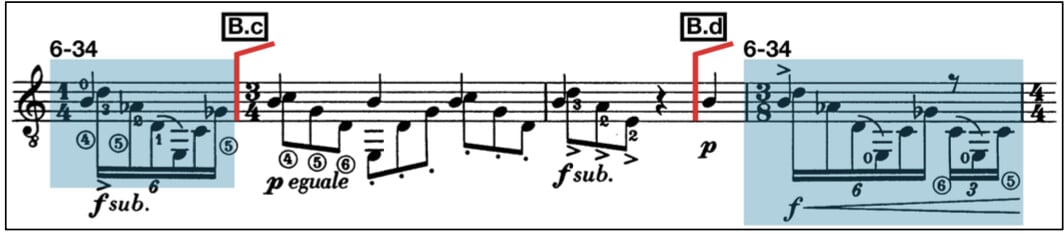
Subsection B.c is a literal repetition of Subsection B.a. Immediately following subsection B.c there is a break in the constant texture. This is immediately followed by subsection B.d that is comprised by a slightly expanded iteration of the contrasting sextuplet gesture first presented on mm.12. This iteration conserves the same Forte name, 6-34.
Section A₁ presents an instance of a short-scale recapitulation nested within the expositional macro section. This section directly recalls material first presented in Section A. Specifically in subsections A.c, and A.d. The A₁ section can be divided in two subsections defined in table 5.
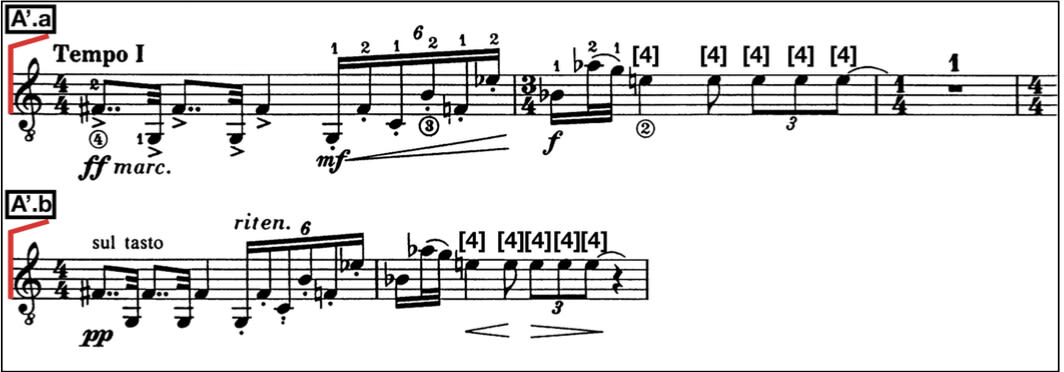
Subsection A₁.a combines the ending gesture of subsection A.c and the entirety of A.d. In this iteration, the material is strictly transposed down by a minor 3rd . Due to the nature of strict transposition, the Forte name for the aggregate pitch-collection describing Subsection A₁.a is the same as the one describing the corresponding sectors of the A section, 9-4. Subsection A₁.b is an exact repetition of A₁.a at a softer dynamic.
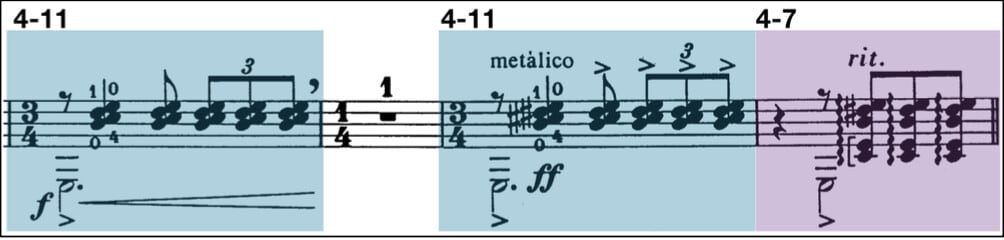
Section D consist of a sequence of three tetra-chords, further develops the theme of reiteration, and marks the end of the expositional macro section. The first two tetra-chords share the same Forte name, 4-11. Contrastingly, the last tetra-chord has a Forte name of 4-7.
Developmental macro section
The developmental macro section of this movement is comprised of a single section, E. This macro-section further elaborates on the theme of reiteration and introduces a triplet-feel drone on pitch-class [4] and introduces a faster tempo mark, “Allegro moderato”. Section E is divided in two subsections defined in table 6.
Subsection E.a introduces a rhythmic ostinato focused on pitch-class [4]. This ostinato is followed by a complementary short melodic line as presented in mm. 26. The pitch-collection describing the section of music from mm. 25 to mm. 27 has the Forte name 6-z25. Following this, on mm. 28, an arpeggiated chord is presented. This chord is closely resembles the opening chord presented in subsection A.a. In this iteration however, the Forte name changes from 6-z24 to 6-z26, this without counting pitch-class [4].
![Fig. 14. [object Object]](https://res.cloudinary.com/dpxg2qvgb/image/upload/f_auto,q_auto/v1768953217/fig_14_u6zpr2.jpg)
The music continues iterating the musical material presented above until the melodic line on mm. 31 marks the end of Subsection E.a. This melodic figure is derived from the one presented in mm. 26. In this iteration, different rhythmic values are used in addition to the inclusion of pitch-classes [2] and [5].
![Fig. 15. [object Object]](https://res.cloudinary.com/dpxg2qvgb/image/upload/f_auto,q_auto/v1768953217/fig_15_m3ohtr.jpg)
Subsection E.b introduces two gestures. On mm. 33, an ascending gesture is presented. Notice the similarity of this gesture to the one presented on subsection A.c. In this case, Brouwer uses tri-chords 3-7 and 3-8 to create this gesture.
![Fig. 16. [object Object]](https://res.cloudinary.com/dpxg2qvgb/image/upload/f_auto,q_auto/v1768953219/fig_16_ceprnd.jpg)
The second gesture introduced in Subsection E.b has its first appearance in mm. 34. This gesture presents a 3-4 tri-chord that maintains the rhythmic momentum created by characteristic ostinato belonging to the developmental macro section. To end the development, Brouwer gradually decreases the frequency of appearance for the gestures, adds measures of absolute silence, pulls back on the dynamic values of the music, and drastically decreases the tempo. This gradually marks the end of the development and signals the start of the recapitulatory macro section represented by the reiteration of the first tempo mark, “Lento”.
![Fig. 17. [object Object]](https://res.cloudinary.com/dpxg2qvgb/image/upload/f_auto,q_auto/v1768953220/fig_17_rykkxh.jpg)
Recapitulatory macro section
The recapitulatory macro section of this movement is comprised of a single section, A₂. This macro section recalls material belonging to the exposition and development. A₂ is divided in three subsections defined in table 7.
![Fig. 18. [object Object]](https://res.cloudinary.com/dpxg2qvgb/image/upload/f_auto,q_auto/v1768954835/fig_18_pgyauj.jpg)
Subsection A₂.a presents arpeggiated chords that closely resemble the one present in subsection A.b. These iterations have the Forte name 6-z19 and keep the repetition of the highest voice in the chord, pitch-class [t].
![Fig. 19. [object Object]](https://res.cloudinary.com/dpxg2qvgb/image/upload/f_auto,q_auto/v1768954835/fig_19_iszgmf.jpg)
Immediately afterwards, a transposed and slightly transformed iteration of the gesture first presented in subsection A.c, and later in subsection A₁, appears in subsection A₂.b. In this iteration, Brouwer construct the accelerating descending gesture using tri-chords 3-1 exclusively. Additionally, a short fragment of the rhythmic ostinato on pitch-class [4] belonging to the development appears.
![Fig. 20. [object Object]](https://res.cloudinary.com/dpxg2qvgb/image/upload/f_auto,q_auto/v1768954836/fig_20_j5xfan.jpg)
Finally, subsection A₂.c restates the arpeggiated penta-chord 5-z17 that opened the movement three times. These statements of the penta-chord are also highlighted by the already familiar repetition of the highest pitch-class [1].
![Fig. 21. [object Object]](https://res.cloudinary.com/dpxg2qvgb/image/upload/f_auto,q_auto/v1768954838/fig_21_gnuzde.jpg)
Conclusion
Brouwer is efficient in its use of gestural material. This analysis deconstructed the first movement of “Elogio de la Danza” and made it apparent that there are strong arguments suggesting that all musical material can be traced back to the expositional macro section, specifically, subsection A. Additionally, the importance of pitch-class [4] becomes irrefutable. It is worth mentioning that the next and final movement of this work starts and ends on chords that have pitch-class [4] as the root. Furthermore, this analysis showed how Brouwer used closely related pitch-set to craft the harmonic framework for this composition. Prominent pitch-collections in this movement include: 5-z17, 6-z19, 6-z24, 6-z25, 6-z26. Perhaps more importantly, the unifying force in this movement lies in the reiteration of musical material, whether pitch classes, pitch collections, gestures, or ostinatos. This reiteration creates a cohesive framework for the presentation and development of musical ideas.